
Goal Zero
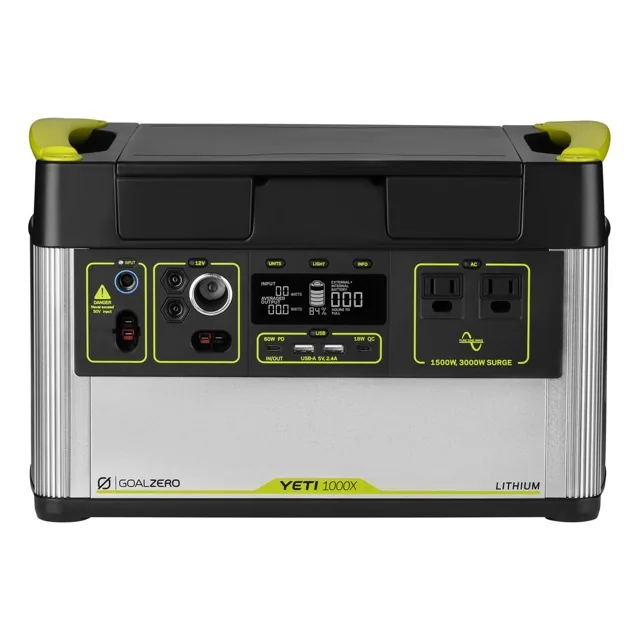
Goal Zero Yeti 1000X
$999.95 · Lifetime $2.01/kWh over 500 rated cyclesChecked against Goal Zero's product page today.
We may earn a commission from these links, at no cost to you. How we make money
What it actually runs
Usable energy ≈ 847 Wh after our standard 85% inverter-efficiency assumption. Methodology
| CPAP overnightCPAP, humidifier off (40 W × 8 h) | ~21 h continuous · 2.6 days at typical daily use |
|---|---|
| EssentialsFridge + wifi + 3 lights (~190 W continuous) | ~4.5 h continuous · 0.5 days at typical daily use |
| Storm kitFridge + sump pump + lights + phones (~1,000 W) | ~0.8 h continuous · 0.2 days at typical daily use |
| Quick equivalents | ≈ 2 CPAP nights · 6 h of fridge · 42 phone charges |
How long will it run YOUR appliance?
Solar recharge
The Yeti 1000X accepts up to 600 W of solar input — panels beyond that sit idle. To sustain an essentials load (~1,680 Wh/day) off-grid you'd need roughly 470 W of panels, within this unit’s cap — sun permitting, it can run essentials indefinitely.
Compatible kits: Goal Zero Boulder 200 (200 W) · Goal Zero Ranger 300 Briefcase (300 W) — proprietary connector; third-party MC4 panels need an adapter.
Specifications
| Capacity | 997 Wh |
|---|---|
| Usable (85%) | 847 Wh |
| AC output | 1,500 W |
| Surge output | 3,000 W |
| Max solar input | 600 W |
| Outage switchover | No passthrough switchover |
| Output waveform | Pure sine wave |
| Battery chemistry | NMC |
| Expandable battery | Yes |
| Rated cycles | 500 |
| Third-party solar | Own-brand panels only |
| Lifetime cost | $2.01/kWh |
Alternatives to consider
- EcoFlow DELTA 2 — 1,024 Wh / 1,800 W at $479 · compare head-to-head →
- EcoFlow DELTA 3 Plus — 1,024 Wh / 1,800 W at $719 · compare head-to-head →
Common questions
How long will the Goal Zero Yeti 1000X run a refrigerator?
About 6 hours of compressor running time — which at a realistic duty cycle covers roughly 0.7 days of normal fridge use. Estimates use usable capacity (85% of rated) and carry ±15%.
Can the Yeti 1000X run a CPAP?
Yes — a 40 W CPAP runs about 2 full nights per charge without humidification. A heated humidifier roughly triples the draw and cuts nights to ~0.
Can it run a space heater?
Yes on output — a 1,500 W heater draws within this unit's 1,500 W rating — but only for ~0.6 hours. Resistive heat is the fastest way to drain any battery; an electric blanket (100 W) runs ~8 hours instead.
How fast does the Yeti 1000X recharge from solar?
At its 600 W input cap, roughly 2.1 hours of good sun for a full refill (real-world 80% derate applied). Cloud cover stretches that substantially.